Haleem's Journey: From Persian Courts to Houston's Tables
By Mr. Haleem · 2026-06-08 · 4 min read
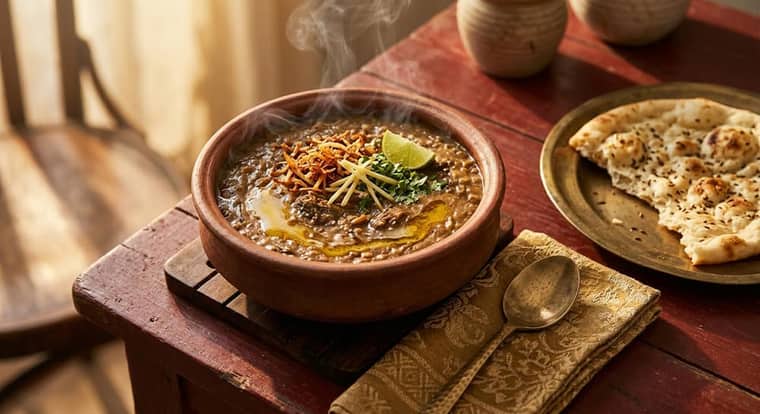
How a 10th-century Persian porridge became Karachi's soul food—and landed on Houston tables at Mr. Haleem.
A Dish Born in Fire and Patience
Long before haleem simmered in the deghs of Burns Road or found its way onto Houston tables, it lived under a different name. Harees—sometimes spelled hareesa—was the meat-and-wheat porridge cooked by Persian and Arab cooks as early as the 10th century. The dish demanded little more than wheat, meat, ghee, and time: hours of slow stirring until grain and protein dissolved into a single, unified mass. It was sustenance and ritual, fuel for laborers and feast for kings.
When the Mughals swept into the Indian subcontinent in the 16th century, they brought Persian court cuisine with them. Harees migrated south and east, morphing along the way. Indian cooks added lentils—masoor, moong, chana—and a symphony of spices: cumin, coriander, turmeric, garam masala. The name softened into daleem, then haleem. What had been a simple porridge became a slow-cooked masterpiece, a dish that required not just heat but devotion.
Hyderabad, Karachi, and the Birth of Regional Souls
By the 18th century, haleem had taken root in two cities that would each claim it as their own.
Hyderabadi Haleem: The Nizam's Legacy
In Hyderabad, the Nizams' kitchens perfected a silken, almost custard-like haleem. Basmati rice joined the wheat and lentils. The tarka—a finishing tempering of ghee, fried onions, and whole spices—became an art form. During Ramadan, the lanes of the Old City filled with the scent of mutton haleem cooked in massive cauldrons, stirred with wooden ladles the size of oars. It was refined, elegant, almost aristocratic.
Karachi Haleem: Burns Road Grit and Glory
Karachi's haleem, by contrast, was born on the street. After Partition in 1947, Urdu-speaking migrants from North India poured into the port city, bringing their recipes and hunger. On Burns Road and Tariq Road, haleem vendors set up shop with enormous deghs that bubbled from dawn till midnight. The Karachi version skewed bolder—more chili, more ginger, more tarka. The texture stayed hearty, less refined than its Hyderabadi cousin, with visible shreds of beef or chicken still distinct in the mix. It wasn't polite. It was real.
This is the haleem Mr. Haleem honors: the slow-cooked Beef Haleem that carries the weight of Burns Road in every spoonful, available in portions from a single serve ($12.99) to a full tray that feeds 18–20 ($156.99).
Why Ramadan and Muharram?
Haleem's place in the Islamic calendar is no accident. Its preparation mirrors the spiritual discipline of fasting and remembrance.
During Ramadan, haleem became the quintessential iftar dish—rich enough to restore energy after a day of fasting, balanced enough not to overwhelm an empty stomach. In Pakistan, no Ramadan table feels complete without it. The ritual of breaking bread (or naan) and dipping it into a steaming bowl of haleem is muscle memory for millions.
During Muharram, the first month of the Islamic calendar and a period of mourning, haleem takes on a different resonance. Shia communities across Pakistan and India prepare vast quantities to distribute as nazr (votive offerings) or to feed mourners at majalis gatherings. It's a dish of care, of feeding the grieving, of turning grain and meat into comfort.
Houston, Karachi, and the Degh That Traveled
When Pakistani families began settling in Houston in the 1970s and '80s, they brought their food memories with them. For years, haleem in Houston meant homemade batches cooked in suburban kitchens, or the occasional special at a restaurant that didn't quite get the texture right.
Mr. Haleem changed that. Our kitchen doesn't take shortcuts. We cook our Beef Haleem and Koozi (Chicken) Haleem the old way—low, slow, and long—until the grains break down and the spices marry into something that tastes like home. We offer gluten-free haleem trays for those who need them, because tradition should be accessible.
Every bowl we serve in Houston is a thread connecting back to Burns Road, to the Mughal deghs, to the Persian harees cooked a thousand years ago. It's a dish that refuses to be rushed, a dish that asks you to sit, to taste, to remember.
What Haleem Teaches Us
Haleem isn't fast food. It isn't fusion. It's the kind of cooking that rewards patience, that turns humble ingredients—wheat, lentils, meat, spice—into something transcendent. It's proof that the best haleem in Houston isn't about flashy plating or Instagram angles. It's about honoring a recipe that has survived empires, migrations, and centuries.
And it's about knowing that when you order a single serving or a full tray for your next gathering, you're not just eating dinner. You're taking part in a story that stretches from the courts of Persia to the streets of Karachi to a kitchen in Houston where the degh still bubbles, and the tarka still sizzles, and the past still tastes like now.
Browse the menu → · Catering trays → · More from the Mr. Haleem blog →